
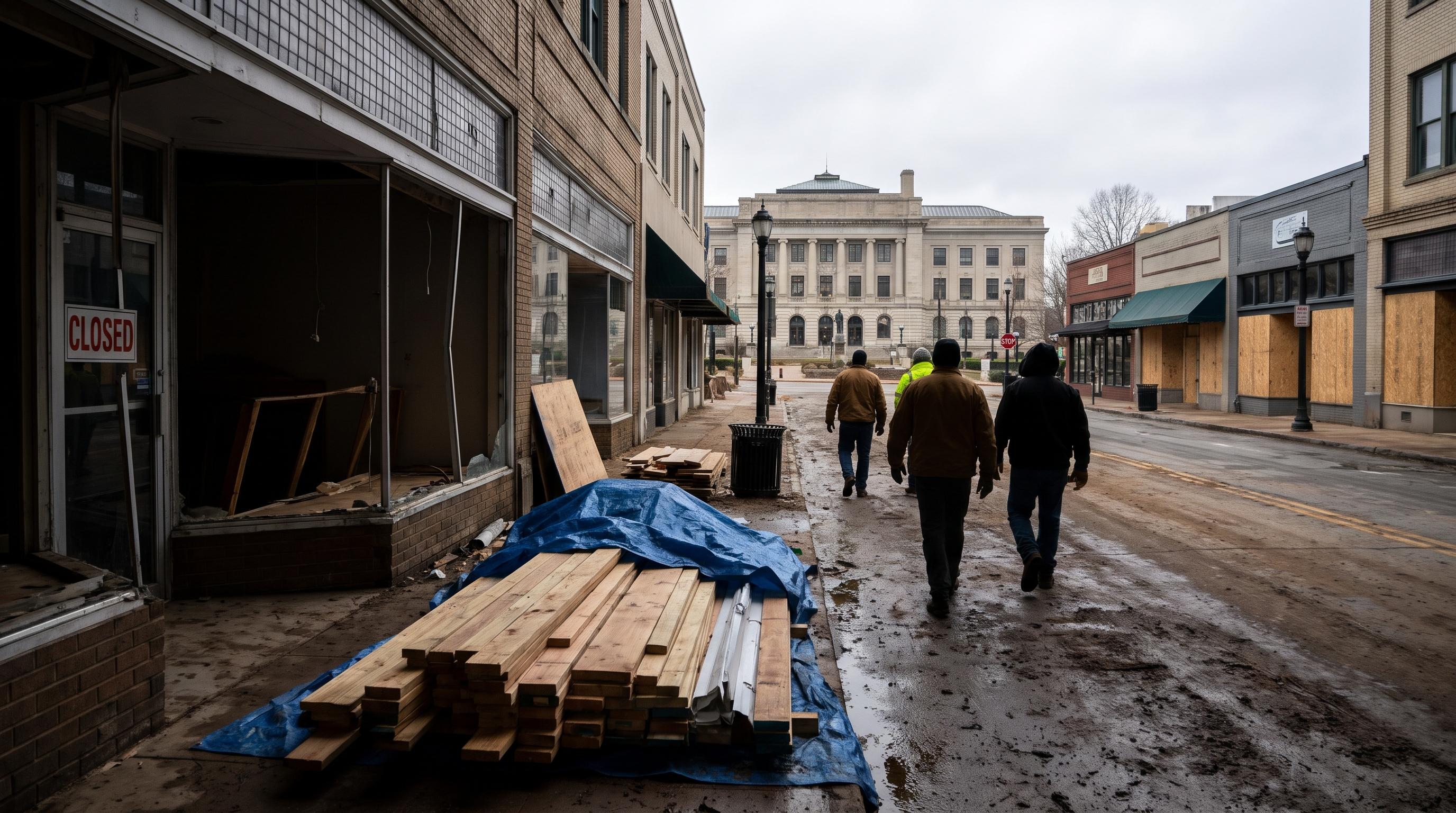
More than two years after Tropical Storm Helene devastated Western North Carolina in September 2024, the City of Asheville confirmed this week that $30 million in federal disaster recovery funds designated for flood-damaged commercial districts remains intact. However, no application date has been set, and city officials do not expect to provide concrete answers on how businesses can apply until early 2027.
While local business owners in hard-hit corridors like Biltmore Village and the River Arts District continue to wait for relief, the delay stems from a combination of federal grant mechanics, mid-stream federal rule changes, overlapping agency requirements, and unresolved local policy decisions.
How the Federal Money Works
The $30 million set-aside does not come from the Federal Emergency Management Agency (FEMA). Instead, it is part of a $225 million Community Development Block Grant–Disaster Recovery (CDBG-DR) package from the U.S. Department of Housing and Urban Development (HUD).
Under federal grant regulations (2 CFR Part 200), HUD does not wire lump-sum checks to local governments upfront. When HUD executed Asheville’s grant agreement in August 2025—following its January 2025 allocation and May 15, 2025 Action Plan approval—it established a federal line of credit in the U.S. Treasury. Asheville can only draw money down piece by piece to reimburse eligible expenses after specific projects are approved and bills are incurred. Because no commercial corridor grants have been awarded, $0 of the $30 million has been transferred from the Treasury to the city.
Mid-Stream Federal Rule Changes and Bottlenecks
Several federal shifts and statutory requirements across HUD, the Small Business Administration (SBA), FEMA, and federal flood insurance have directly affected the pace of recovery:
Mid-Stream HUD Rule Rewrites: On January 8, 2025, HUD published a standardized "Universal Notice" designed to speed up disaster recovery rules. Two months later, on March 19 and March 31, 2025, HUD issued memoranda rewriting compliance and verification rules within that notice to align with new federal executive orders. Grant recipients had to pause and update local compliance frameworks, while HUD later issued Policy Bulletin 2026-04 and 60-day extensions to address resulting administrative backlogs. In July 2026, Congress passed the Reforming Disaster Recovery Act to create permanent statutory timelines and upfront startup grants for future disasters, though the law did not retroactively change Asheville’s 2025 grant rules.
Duplication of Benefits Checks: Federal law strictly prohibits businesses from receiving HUD grant money for losses already covered by private insurance, FEMA, or an SBA disaster loan. Because CDBG-DR acts as a payer of last resort, local administrators cannot finalize grant awards—and applicants cannot complete applications—until insurance payouts and SBA loans are verified line by line.
SBA Disaster Loan Lapses and Limits: The SBA exhausted its disaster loan funding in October 2024—weeks after Helene struck—halting new loan approvals for more than two months until Congress replenished the fund in late December 2024. When lending resumed, static federal loan limits lagged behind post-storm construction costs, leaving many businesses seeking gap financing before finalizing rebuilding plans.
Federal Shutdowns and Flood Insurance Freezes: During the 43-day federal government shutdown in fall 2025, FEMA paused final sign-offs on recovery reimbursements, and the National Flood Insurance Program (NFIP) lapsed. While existing flood policies remained active, new policy issuances and renewals froze, delaying property closings, commercial leases, and loan approvals in flood-damaged areas.
Environmental and Floodway Reviews: Under federal environmental regulations (24 CFR Part 58), cities and businesses cannot sign construction contracts or spend CDBG-DR funds on physical repairs in floodplains until site-specific environmental and historic-reservation reviews are completed. Federal rules also prohibit building inside a designated floodway or purchasing movable equipment with these funds.
Local Policy Debates and Unfinished Guidelines
Alongside federal compliance rules, the City of Asheville has yet to finalize how it wants to structure the $30 million program. Through mid-2026, city staff focused on launching the separate $17 million Asheville Recovers Together small business grant program—which closed applications in July 2026 and began issuing award notices in October 2026—as well as passing a June 2026 Action Plan amendment that shifted $19.2 million into single-family home repairs.
At a September 2026 City Council workshop, staff asked council members for policy direction on basic design questions for the $30 million commercial corridors fund, including whether money should go toward direct business grants, building floodproofing, or district-wide stormwater and streetscape infrastructure, and whether nonprofits should be eligible to compete. Council members declined to narrow those options without additional data on existing public investments and corridor recovery needs.
City economic revitalization staff confirmed this week that no formal amendment has been proposed to alter the $30 million allocation. Any formal change to eligible applicants or program rules would require a 30-day public comment period, a City Council vote, and HUD approval before applications can open.
Sources:
U.S. Department of Housing and Urban Development (HUD) — Universal Notice for Community Development Block Grant–Disaster Recovery (CDBG-DR) Funds (January 8, 2025) and Revised Implementation Memoranda (March 19 and March 31, 2025)
U.S. Department of Housing and Urban Development (HUD)
U.S. Department of Housing and Urban Development (HUD) — City of Asheville CDBG-DR Action Plan Approval (May 15, 2025) and Executed Grant Agreement Records (August 2025)
Code of Federal Regulations — 2 CFR Part 200 (Uniform Administrative Requirements, Cost Principles, and Audit Requirements for Federal Awards)
Code of Federal Regulations — 24 CFR Part 58 (Environmental Review Procedures for Entities Assuming HUD Environmental Responsibilities)
U.S. Congress — Reforming Disaster Recovery Act provisions within the 21st Century ROAD to Housing Act (July 2026)
U.S. Government Accountability Office (GAO) — June 2026 Report and Testimony on HUD Disaster Recovery Bottlenecks and Unimplemented Audit Recommendations
U.S. Small Business Administration (SBA) — Disaster Loan Program Funding Exhaustion Notices (October 2024) and Supplemental Appropriations Records (December 2024)
Federal Emergency Management Agency (FEMA) and National Flood Insurance Program (NFIP) — Lapse and Reimbursement Pause Notices during the Fall 2025 Federal Government Shutdown
City of Asheville — CDBG-DR Action Plan, June 2026 Action Plan Amendment ($19.2 Million Single-Family Home Repair Reallocation), and Asheville Recovers Together Small Business Support Program Records
City of Asheville — September 2026 City Council Workshop Presentations and Economic Revitalization Staff Statements on the $30 Million Commercial Corridors Allocation