

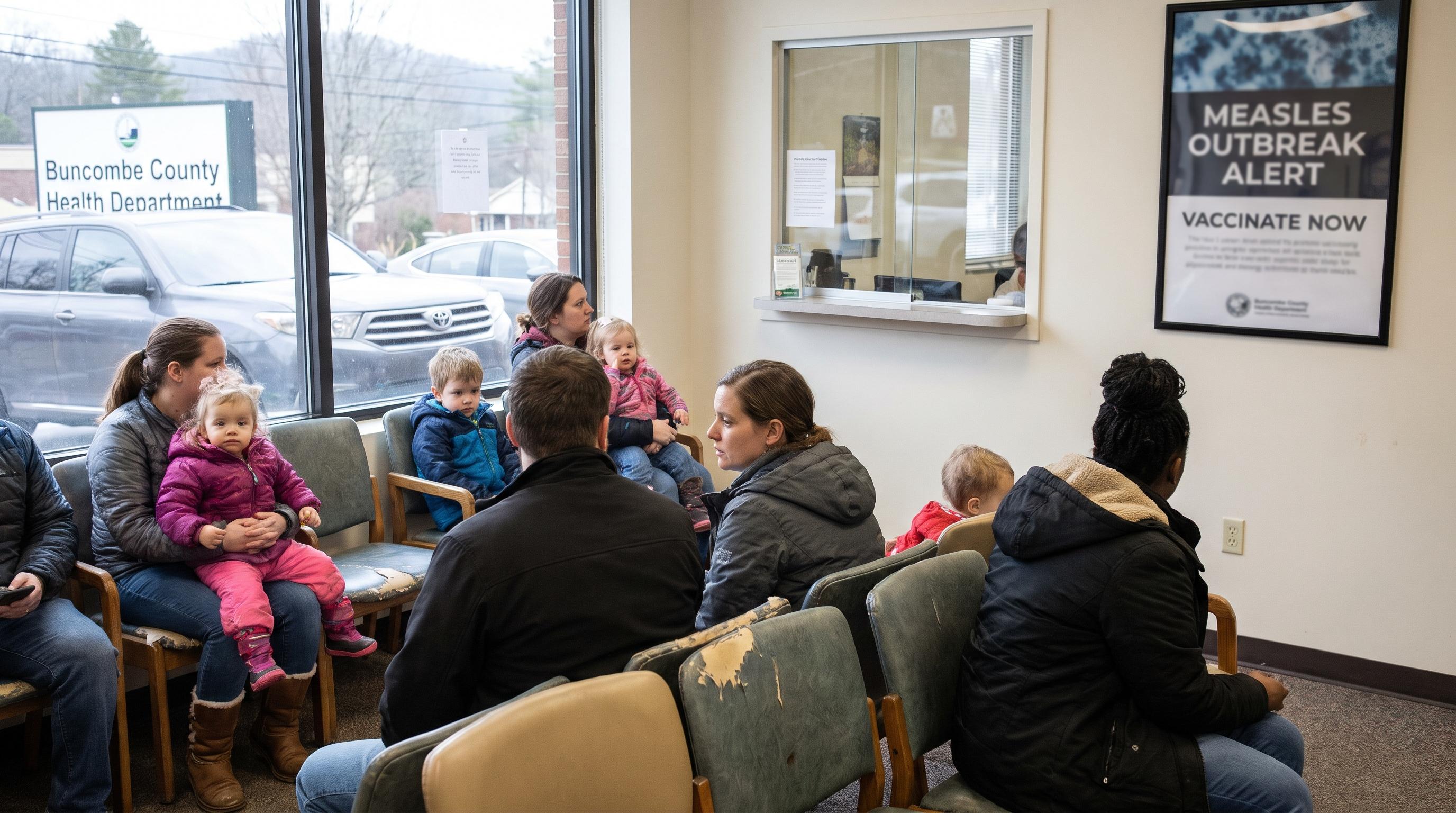
Health News -- November 12, 2026: For the first time since 2000, the United States is on the brink of losing its official measles elimination status—a public health designation confirming that a country has stopped continuous, year-round domestic transmission of the virus.
An independent verification commission convened by the Pan American Health Organization (PAHO) is reviewing U.S. epidemiological and genomic sequencing data this week, with a formal determination by PAHO Director Jarbas Barbosa expected early next week. Under World Health Organization and PAHO criteria, a country loses its elimination status when a single strain of measles spreads uninterrupted within its borders for 12 months or longer.
According to the Centers for Disease Control and Prevention (CDC), the United States has confirmed 5,182 measles cases in 2026 as of early November—more than double the 2,289 cases recorded in all of 2025, and the highest annual U.S. total since the early 1990s. Unbroken transmission chains stretching back to January 2025 pushed the nation past the 12-month mark earlier this year. Canada lost its elimination status in November 2025 following prolonged outbreaks, and Mexico and Guatemala are also under PAHO review this week.
Behind the Resurgence: Falling Coverage and Shifting Federal Policy
Public health officials and infectious disease specialists emphasize that the surge is not caused by any decline in the effectiveness of the measles, mumps, and rubella (MMR) vaccine. Two doses of the MMR vaccine remain 97% effective at preventing infection, and CDC data shows 96% of confirmed U.S. cases in 2026 have occurred in individuals who were unvaccinated or whose vaccination status was unknown.
Instead, the resurgence reflects declining immunization rates driven by converging political, cultural, and policy shifts:
Pandemic-Era Polarization: Skepticism toward federal health agencies and vaccine mandates during the COVID-19 pandemic spilled over into long-standing routine childhood immunizations, turning standard pediatric shots into a polarizing cultural issue.
Federal Leadership and Policy Changes: Since taking over as Secretary of Health and Human Services (HHS) in 2025, longtime vaccine critic Robert F. Kennedy Jr. has ended proactive federal pro-vaccine promotional campaigns, replaced all 17 members of the CDC’s independent Advisory Committee on Immunization Practices (ACIP) with several vocal vaccine skeptics, and shifted federal guidance toward an "individualized decision-making" model rather than universal public health promotion. In August 2026, President Donald Trump signed an executive order directing HHS to evaluate breaking the standard combined MMR shot into three separate single-antigen vaccines—a move medical organizations warned would lower completion rates during an active national surge.
Rising School Exemptions: Across 41 states, non-medical religious and philosophical exemptions from school vaccine requirements have climbed. In North Carolina, non-medical exemptions among kindergartners reached 3.8% for the 2025–2026 school year, dropping statewide kindergarten MMR coverage to 93.7%—down from 96.1% in the 2021–2022 school year.
Why Geography and Travel Matter in Western North Carolina
While North Carolina has recorded zero new confirmed measles cases since February 2026, state and local health officials warn that Western North Carolina’s geography and tourism-driven economy create distinct exposure risks.
Measles is one of the most contagious known viruses: roughly 9 out of 10 unvaccinated people exposed to it will contract the illness, and viral particles can linger in the air for up to two hours after an infected person leaves a room. To prevent imported cases from sparking sustained local outbreaks, epidemiologists rely on a 95% community vaccination rate ("her immunity")
Below-Threshold Border States: None of the states bordering Western North Carolina currently meet the 95% kindergarten MMR herd-immunity benchmark. Tennessee stands at 94.4%, Virginia at 93.6%, South Carolina at 93.4%, and Georgia at 89.1%.
Proven Cross-Border Spillover: Between October 2025 and April 2026, Spartanburg County, South Carolina—roughly an hour south of WNC, where local MMR coverage stood at 88.9%—experienced a 997-case outbreak. That Upstate South Carolina outbreak directly seeded a winter cluster of 24 confirmed cases across 10 North Carolina counties between December 2025 and February 2026.
Heavy Seasonal and Tourist Traffic: Year-round tourism, seasonal residents, and major interstate corridors bring millions of visitors into mountain towns from across the country. In late August 2026, the N.C. Department of Health and Human Services (NCDHHS) issued public exposure notices for locations in Asheville and Hendersonville after an infectious out-of-state traveler passed through Buncombe and Henderson counties. While existing community immunity prevented secondary cases then, localized pockets of under-vaccinated residents remain vulnerable whenever the virus is introduced.
What Losing Elimination Status Means
osing elimination status does not trigger border closures or travel bans, nor does it change individual protection for vaccinated residents. Rather, it formally classifies measles as endemic—meaning it is circulating continuously inside the U.S. rather than appearing solely through isolated international travel.
That shift carries concrete consequences:
Higher Risk for Vulnerable Residents: Continuous domestic circulation increases day-to-day exposure risks in clinics, schools, and public venues for infants under 12 months who are too young for their first routine MMR dose, pregnant women, and immunocompromised individuals. In 2026, 11% of confirmed U.S. measles patients have required hospitalization, and at least eight measles-related deaths have been reported nationwide—including young children and infants in New York, Wisconsin, and Pennsylvania.
Strain on Local Health Budgets: Public health studies estimate that containing a single measles case costs local health departments an average of nearly $60,000 in contact tracing, laboratory testing, quarantine monitoring, and emergency clinics.
A Multi-Year Path Back: Regaining elimination status requires stopping all continuous domestic transmission for at least 12 consecutive months and restoring community vaccination coverage to 95%. Brazil, which lost its elimination status in 2019, required five years of sustained immunization drives to earn the designation back in 2024.
North Carolina’s Response and Local Resources
While federal agencies have stepped back from mass pro-vaccine campaigns, North Carolina maintains an active state-level prevention and surveillance framework through NCDHHS and county health departments:
No-Cost Vaccine Access: In January 2026, NCDHHS expanded its state-funded 317 Vaccine for Adults (VFA) program so uninsured, underinsured, and copay-burdened adults can receive free MMR doses at local health departments. Children under 19 who are uninsured, Medicaid-eligible, or underinsured qualify for free MMR shots through the federal Vaccines for Children (VFC) program.
School Requirements and Outbreak Rules: Under North Carolina law (
G.S. 130A-155), students entering K–12 schools and licensed childcare centers must provide proof of two MMR doses unless they hold a documented medical or religious exemption. If a confirmed case occurs in a school, state rules (10A N.C.A.C. 41A) authorize local health directors to exclude unvaccinated students—including those with exemptions—for up to 21 days.Wastewater and Outbreak Tracking: NCDHHS conducts twice-weekly testing across 36 wastewater treatment sites statewide (including in Buncombe County) to detect silent viral circulation early and updates its public Measles Outbreak Dashboard every Tuesday and Friday at
dph.ncdhhs.gov.
Checking Your Status in WNC
Adults born before 1957 are generally presumed immune from widespread childhood exposure prior to the vaccine's introduction. Adults vaccinated between 1963 and 1967 may wish to check with their healthcare provider to confirm they received a live-virus vaccine rather than an earlier inactivated version.
Loocal Health Departments: Residents who need to check state immunization records or schedule a free or low-cost MMR shot can contact their healthcare provider or local health department.