

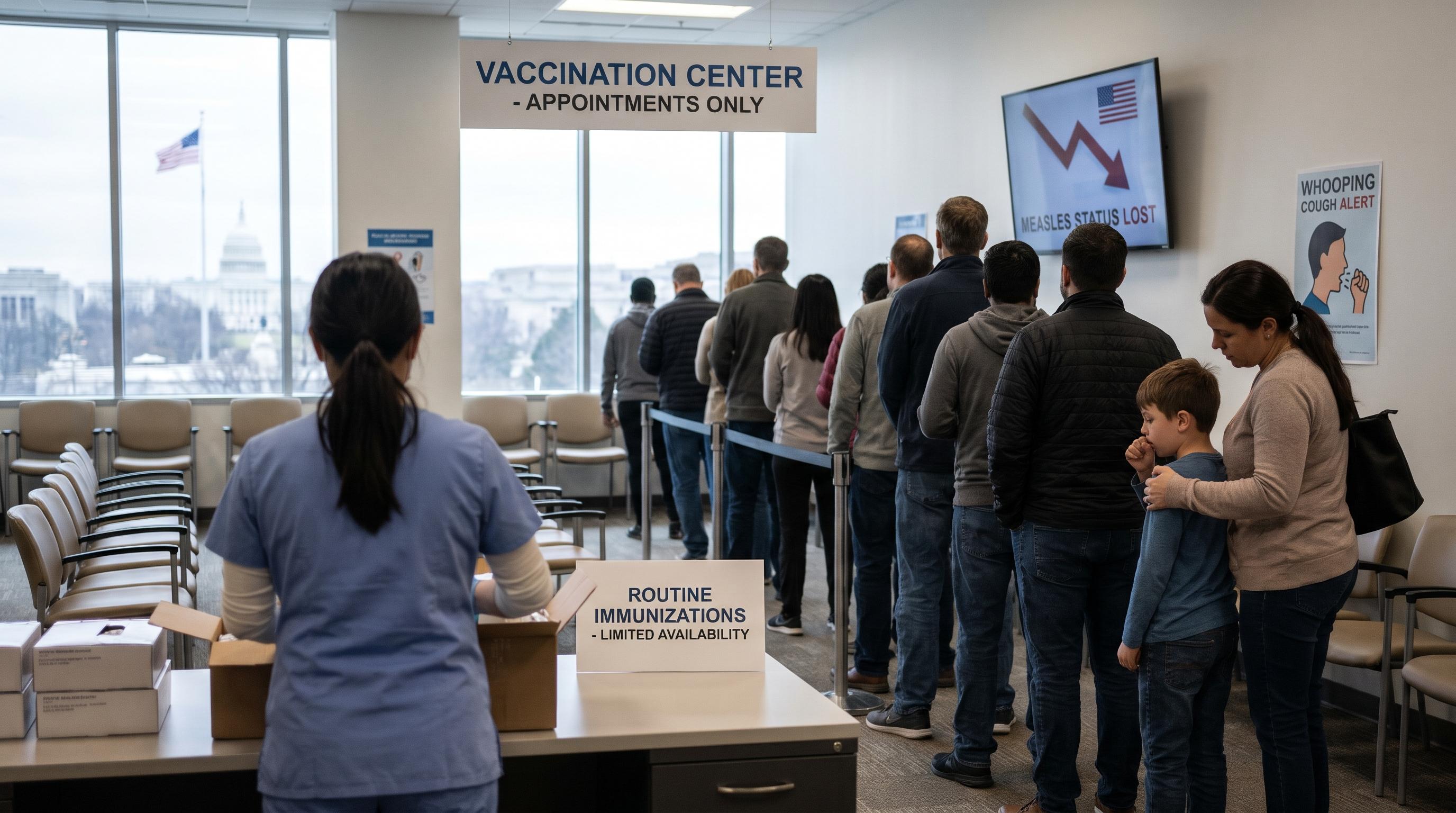
U.S. Health News -- November 14, 2026: fter 26 years of keeping endemic measles out of the country, the United States is losing its measles elimination status. Following a November 10–13 review of genetic and epidemiological data, an expert commission with the Pan American Health Organization (PAHO) determined that the virus has circulated uninterrupted inside the U.S. for more than 12 months—a milestone set to be formally announced by PAHO leadership. The setback comes amid more than 5,400 confirmed measles cases nationwide, a broad drop in routine childhood immunizations, elevated whooping cough levels, and sweeping changes to federal vaccine policy.
A Historic Setback Driven by Falling Immunity
The United States achieved measles elimination in 2000 after decades of school immunization ws and public health outreach pushed vaccination coverage above 97%. Under international health rules, a country forfeits that status if the same genetic strain of measles spreads continuously within its borders for 12 months or longer. Outbreaks that began in January 2025 continued uninterrupted through 2026, resulting in 5,412 confirmed cases as of mid-November—the highest U.S. total in more than 30 years. State health departments have reported 10 measles-associated deaths nationwide in 2026, while the CDC’s federal tally currently lists six.
Epidemiologists emphasize that measles is among the most contagious viruses known, requiring at least 95% community immunity to prevent imported cases from sparking sustained outbreaks . During the 2025–2026 school year, national coverage for the measles, mumps, and rubella (MMR) vaccine among U.S. kindergartners fell to 92.4%, leaving roughly 280,000 incoming students without documentation of full MMR protection. Thirty-nine states now sit below the 95% herd immunity threshold.
How Skepticism Spread Beyond Measles to Other Routine Vaccines
The decline in immunization is not isolated to measles. Federal data released by the Centers for Disease Control and Prevention (CDC) for the 2025–2026 school year shows that vaccination coverage dropped across all reported routine childhood vaccines compared to the prior year: MMR (Measles, Mumps, Rubella): 92.4%
Polio: 92.4%
DTaP (Diphtheria, Tetanus, and Pertussis/Whooping Cough): 92.0%
Varicella (Chickenpox): Decreased in more than half of U.S. statesthe same time, the share of U.S. kindergartners claiming an exemption from one or more required school vaccines climbed to a record high of 4.2%—roughly 155,000 children—with exemptions rising in 41 states and Washington, D.C.
Public health researchers trace this broader retreat from routine immunization to a convergence of post-COVID-19 polarization and major shifts in federal leadership:
Post-Pandemic Spillover: During the COVID-19 pandemic, public clashes over vaccine mandates and frequent attacks by President Donald Trump on federal health agencies like the CDC and FDA eroded trust in public health guidance. Skepticism that began around COVID-19 shots increasingly spilled over into long-established childhood vaccines.
Federal Policy Overhauls: After returning to the White House in 2025, Trump appointed Robert F. Kennedy Jr.—a prominent longtime critic of vaccines—as Secretary of Health and Human Services (HHS). Kennedy dismissed the existing independent experts on the CDC's Advisory Committee on Immunization Practices (ACIP), replacing them with several vaccine skeptics chedule Cuts, Court Battles, and Mixed Messages: In January 2026, following a directive from Trump, HHS moved to cut the list of universally recommended childhood immunizations from 17 diseases to 11. Although a federal judge temporarily stayed those schedule changes in March 2026 pending a lawsuit by the American Academy of Pediatrics—leaving the original schedule legally in effect for now—Trump’s August 2026 executive order urging that the combined MMR shot be broken into separate visits added further confusion for parents and school health officials.
Schedule Cuts, Court Battles, and Mixed Messages: In January 2026, following a directive from T
rump, HHS moved to cut the list of universally recommended childhood immunizations from 17 diseases to 11. Although a federal judge temporarily stayed those schedule changes in March 2026 pending a lawsuit by the American Academy of Pediatrics—leaving the original schedule legally in effect for now—Trump’s August 2026 executive order urging that the combined MMR shot be broken into separate visits added further confusion for parents and school health officials.
Other Diseases Rising or at Heightened Risk
s routine vaccination rates slip, public health officials are tracking elevated case counts and warning signs across several other preventable illnesses:
Whooping Cough (Pertussis): Outside of measles, whooping cough has seen the sharpest multi-year surge in the United States. After hovering between 3,000 and 7,000 annual cases in the early 2020s, U.S. cases spiked to 35,435 in 2024 and reached 28,783 confirmed cases and 16 deaths in 2025. While preliminary CDC data shows 2026 weekly totals trending slightly below 2025’s pace, more than 15,600 cases were still recorded over the past 12 months through mid-November 2026—remaining well above pre-2024 levels. The trend reflects both falling childhood DTaP coverage (92.0%) and adults missing routine Tdap boosters needed to protect infants under six months old.
Chickenpox, Mumps, and Rotavirus: Lower varicella and MMR coverage has contributed to localized school and community clusters of chickenpox and mumps, while pediatric specialists noted localized upticks in severe rotavirus gastroenteritis in 2026 following federal efforts to drop rotavirus from the universal childhood schedule.
Polio, Hepatitis B, and Meningococcal Disease: While no new domestic paralytic polio cases have been recorded since the 2022 Rockland County, New York case, falling polio vaccination coverage leaves under-vaccinated pockets vulnerable if the virus is reintroduced through international travel. Infectious disease specialists also warn that replacing universal newborn Hepatitis B shots and routine adolescent meningococcal recommendations with optional "shared clinical decision-making" risks future increases in chronic infant liver infections and bacterial meningitis.
Seasonal Flu and RSV: Lower uptake of annual influenza and RSV immunizations has added to seasonal hospitalization pressures among young children and adults aged 65 and older. Navigating Tighter Access to COVID-19 Vaccines
While routine childhood shots remain legally available—and required for school attendance in all 50 states unless a medical or non-medical exemption applies—access to COVID-19 vaccines has become far more restricted and uneven across the country.
Narrower Federal Approval: The FDA approved updated 2026–2027 COVID-19 vaccines specifically for adults aged 65 and older and for younger individuals with at least one underlying high-risk medical condition. Healthy adults under 65 and healthy children are no longer covered by a universal federal recommendation; instead, CDC guidance places them under "shared clinical decision-making," meaning patients must consult a healthcare provider, and use outside FDA-approved high-risk groups is classified as off-label.
Pharmacy Barriers and State-by-State Patchwork: Because many retail pharmacies rely on strict FDA approvals and ACIP recommendations to administer shots without a doctor's prescription, healthy adults and parents seeking COVID-19 vaccines for healthy children have faced refusals or extra hurdles at pharmacy counters in several states. In response, more than a dozen states—including North Carolina, New York, Illinois, California, and others—issued separate state-level directives authorizing pharmacists to administer the vaccines more broadly or tying state rules to medical society guidelines rather than federal panels.
Insurance Uncertainty:
While major insurance trade groups indicated coverage would continue through 2026, health experts note that narrowed federal recommendations have created confusion over whether all private plans will cover off-label shots for healthy individuals under 65 without out-of-pocket costs.
What Happens Next
Losing measles elimination status carries no automatic international penalties, and health officials note the designation can be regained if the U.S. halts continuous domestic transmission for 12 consecutive months. However, infectious disease specialists warn that unless vaccination rates recover above the 95% threshold and clear, science-backed guidance is restored, the country faces ongoing outbreaks of measles alongside heightened vulnerability to whooping cough, olio, and other preventable diseases.
Sources
Pan American Health Organization (PAHO) — Regional Verification Commission for Measles, Rubella, and Congenital Rubella Syndrome Elimination review
Centers for Disease Control and Prevention (CDC) — Measles Cases and Outbreaks surveillance data (2025–2026)
Centers for Disease Control and Prevention (CDC) — SchoolVaxView: Vaccination Coverage and Exemptions among Kindergartners (2025–2026 school year)
Centers for Disease Control and Prevention (CDC) — Pertussis (Whooping Cough) Surveillance and Trends and 2025 Provisional Pertussis Surveillance Report
Centers for Disease Control and Prevention (CDC) — 2026–2027 COVID-19 Vaccination Guidance and Advisory Committee on Immunization Practices (ACIP) recommendations
U.S. Food and Drug Administration (FDA) — Vaccines and Related Biological Products Advisory Committee (VRBPAC) and 2026–2027 COVID-19 vaccine approval labels
U.S. Department of Health and Human Services (HHS) and The White House — 2026 childhood immunization schedule directives and August 2026 executive order on childhood vaccine recommendations
American Academy of Pediatrics (AAP) — Recommended Childhood and Adolescent Immunization Schedule and federal court filings regarding 2026 HHS schedule changes
State Departments of Health (including Pennsylvania, Wisconsin, New York, and North Carolina) — 2026 measles fatality reports and state-level pharmacy COVID-19 vaccine standing orders
KFF (Kaiser Family Foundation) — Health Tracking Polls on vaccine confidence, partisan trends, and state COVID-19 vaccine access policies
Center for Infectious Disease Research and Policy (CIDRAP) at the University of Minnesota — U.S. measles resurgence and vaccine policy reporting