

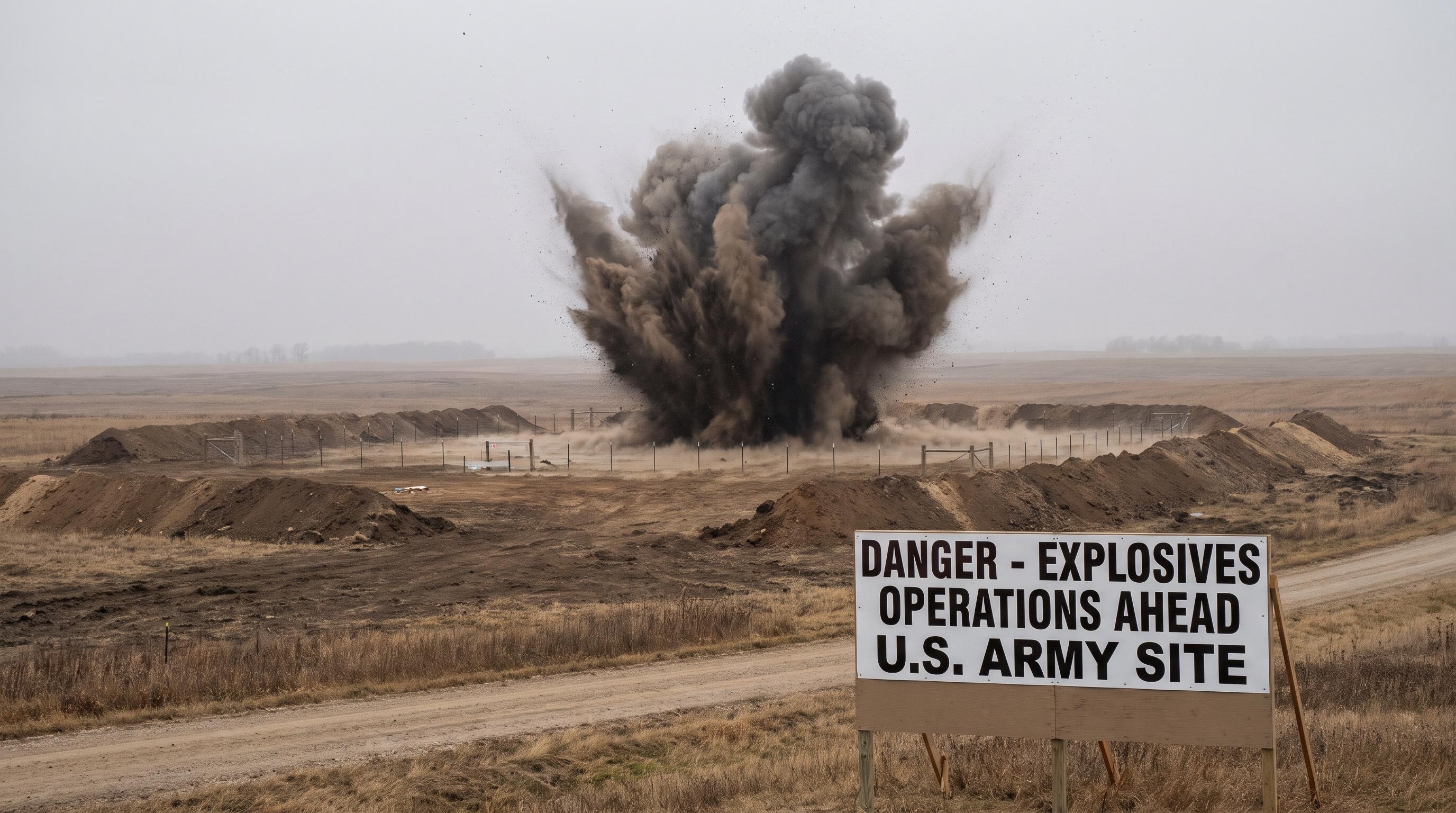
Middletown Iowa News -- November 23, 2026: The U.S. Army is moving forward with plans to conduct two controlled detonations on Wednesday, November 25, 2026, to destroy roughly 9,500 pounds (nearly 5 tons) of deteriorating lead azide inside storage bunkers at the Iowa Army Ammunition Plant in Middletown, Iowa.
The planned blast—the first of its scale near populated communities in modern U.S. history—will send a plume of dust containing elemental lead over parts of southeastern Iowa and western Illinois. The operation is proceeding under federal emergency exemptions even after a federal appeals court paused the Environmental Protection Agency (EPA) permit for the project.
What Is Being Detonated—and Why
Lead azide is a primary explosive compound—roughly 71% elemental lead by mass—used in small quantities inside military blasting caps and primers to ignite larger munitions. To keep bulk quantities stable, the military stores the material underwater or submerged in a bath of ethanol and water.
According to Army Sustainment Command spokesperson Justine Barati, 68 barrels of lead azide had been stored in earth-covered concrete bunkers at the Middletown facility for more than 20 years. During a routine inspection in March 2026, contractors discovered that much of the stabilizing liquid had evaporated. When lead azide dries out, it forms sharp crystals that are hypersensitive to friction, static electricity, and temperature drops.
n a community fact sheet, the U.S. Army stated that moving or opening the drums carries an unacceptable risk of an accidental, uncontained explosion: "Lead azide is a highly sensitive explosive. As it degrades over time it has the potential to become extremely unstable and sensitive to even slight friction or movement. Packing and transporting it poses an unacceptable risk of accidental detonation to personnel handling and transporting as well as to the public. Safely destroying it in place is the only responsible option."
A Paper Trail Stretching Back Decades
While federal officials have framed the blast as an urgent response to incoming freezing temperatures, public records show the stockpile's deterioration spans decades—and that communities were given less than a week's notice before the original November 20 blast date:
Decades in Storage: Under federal hazardous waste laws, facilities cannot store hazardous waste indefinitely without strict disposal deadlines. However, because the military classified the barrels as active production inventory for more than 20 years, they were exempt from hazardous waste disposal rules until the liquid id evaporated and the material degraded.
The 2004 Warning: A 2014 U.S. Army release reveals the Defense Department previously flagged a 40-year-old stockpile of deteriorating lead azide at the exact same Middletown plant in 2004—dating back to the 1960s. Officials have not confirmed whether the current 68 barrels are leftovers from that stockpile or a separate batch.
Canceled Chemical Treatment: In March 2026, the Army hired a contractor to chemically eutralize the lead azide—a process that breaks down the explosive without creating an airborne lead plume. Two months later, the Army canceled the contract after munitions chemists determined that opening or probing the degraded drums risked a fatal blast on site.
Delayed Public Notification: Although the Army reported the evaporation in March and briefed the EPA behind closed doors in April, local towns, school districts, and state officials were not formally notified of the plume models until mid-November.
Legal Maneuvering Around a Federal Court Stay
To reduce airborne dust, crews are stacking two-story sand-filled Hesco barriers around the bunkers, saturating surrounding soil with water, and running water misters during the two rapid-fire blasts. Still, independent scientists, doctors, and agricultural specialists warn that detonating the compound does not eliminate the lead:
Unprecedented Scale:"It's completely unprecedented as far as I know," said Patrick O’Shaughnessy, professor of occupational and environmental health at the University of Iowa. "I've never heard of such a thing where there's apparently no other option to get rid of this stuff other than to blow it up on site." O’Shaughnessy warned that while wind may dilute the initial cloud, "that means it smears it out more," raising long-term concerns about lead settling on playground equipment, crops, and residential yards.
A Persistent Heavy Metal: Because lead is a basic chemical element, heat and explosions do not destroy it—they turn it into microscopic dust that settles onto soil, water, and buildings. "Once we do it, then it becomes considered a viable option for other situations in other places," said Peter Thorne, professor emeritus at the University of Iowa College of Public Health. "So, we expose Iowans this time, but how many more times will we think of doing this and think it's okay now?" Thorne also noted that rinsing off outdoor surfaces does not remove the metal: "The lead doesn't go away. Instead, it washes into the dirt." Thorne also noted that lead is a persistent chemical element that never decomposes or disappears—meaning rinsing off outdoor surfaces does not remove the metal, it washes the lead into the surrounding dirt.
Livestock and Farm Precautions: Agricultural officials have advised farmers in southeastern Iowa and western Illinois to move cattle indoors with ventilation fans turned off, cover outdoor feed and water tanks, and collect baseline soil and forage samples before the blast. "Be proactive and get baseline soil samples this weekend," Illinois Beef Association President Shannon Welsh told producers. "Be prepared to supplement fresh water if you are in a place where this dust is a problem."
State and federal lawmakers from both states are calling for a formal investigation into how the stockpile was allowed to deteriorate for decades without public disclosure.
"I also believe we need a full investigation into why this stockpile of lead azide, which has been at IAAAP for decades, was allowed to degrade into this critical state, why safer methods of disposal were not pursued, what other potentially dangerous materials are being stored at the IAAAP and their condition, and what procedures are needed to ensure this never happens again," said Iowa Senator-elect Josh Turek. "The public also deserves answers as to why the U.S. Army's communication — both with the public and with Iowa officials — was delayed and inadequate from the beginning."
esearchers at the University of Iowa, led by environmental scientist David Cwiertny, are deploying independent air monitors and particle filters across southeast Iowa ahead of Wednesday's detonation to measure actual lead fallout on the ground. Residents, property owners, and farmers who experience structural damage—such as shattered windows—or contamination can file formal damage claims with the U.S. Army using Standard Form 95.
Sources & Documentation
U.S. Army & Pentagon: U.S. Army Joint Munitions Command and Army Sustainment Command Community Fact Sheets; public statements by spokesperson Justine Barati and Acting Secretary of the Army Adam Telle; U.S. Army 2014 historical research release on Iowa Army Ammunition Plant lead azide.
Federal Court & EPA Records: U.S. Court of Appeals for the 8th Circuit administrative stay order (Nov. 19, 2026); U.S. Department of Justice emergency notice (Nov. 21, 2026); EPA Region 7 Emergency Hazardous Waste Permit and Environmental Assessment (Nov. 2026).
Public Health & Scientific Statements: Iowa Department of Health and Human Services Planned Lead Azide Detonation Fact Sheet (Nov. 2026); University of Iowa College of Public Health (Patrick O’Shaughnessy, Peter Thorne, David Cwiertny); Environmental Health Trust (Devra Davis, MPH, PhD).
Agricultural & Legislative Statements: Illinois Beef Association (Shannon Welsh); Iowa State University Extension; official statement from Iowa Senator-elect Josh Turek (Nov. 22, 2026).
News Reporting: Iowa Public Radio, CBS News Chicago, Capitol News Illinois, Newsweek, TIME, Al Jazeera, and Bleeding Heartland reporting (Nov. 19–23, 2026).