

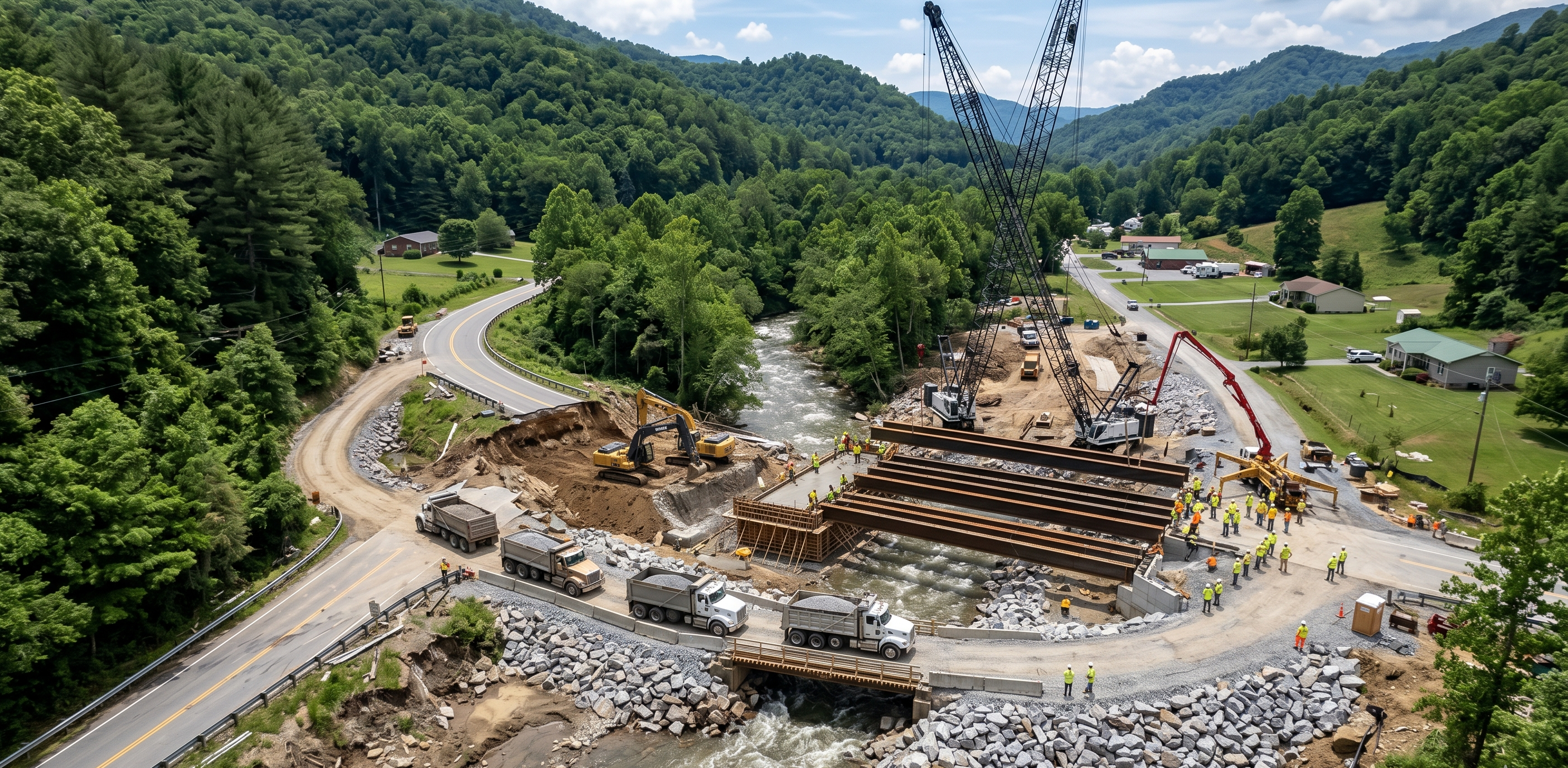
WNC -- June 23, 2026: Members of the Governor’s Advisory Committee on Western North Carolina Recovery met Monday to review the region's transition from immediate disaster response to long-term rebuilding. While state and federal agencies reported significant progress in debris removal, tourism forecasting, and emergency communications infrastructure, committee members from both sides of the political aisle emphasized that a massive funding gap threatens the region's ultimate stability.
According to data presented at the meeting, federal commitments via FEMA have surpassed $5 billion for recovery efforts stemming from the historic storm. This includes $2.6 billion dedicated to debris removal, $2.2 billion in public assistance grants for local governments, and $566 million distributed in direct survivor assistance. Additionally, Jordan Rink, director of FEMA’s North Carolina Recovery Office, noted that nearly $350 million has been obligated in recent weeks for localized utility restoration, road repairs, and school recovery projects.
Despite these historic injections of capital, state officials estimate total regional damages at approximately $60 billion—leaving a projected $55 billion deficit between current funding and total recovery needs. To address this shortfall, Governor Josh Stein and a bipartisan delegation of regional leaders recently traveled to Washington, D.C., to advocate for a pending $10.1 billion federal aid package.
Housing and Infrastructure Deficits
The meeting laid bare the math striking local communities, particularly regarding housing stabilization.
Matt Calabria, director of GROW NC, reported that while the state’s Renew NC program and localized volunteer networks have successfully repaired or rebuilt over 1,000 homes, the demand severely outstrips current appropriations. Currently, 2,100 eligible households remain completely unfunded under existing housing programs.
A similar bottleneck exists for private infrastructure. Over 3,000 private roads and bridges across the mountain region have applied for emergency assistance. Local leaders noted that without additional federal or state interventions, the vast majority of these crossings remain unfunded, complicating access for rural residents. Furthermore, county governments face a $55 million gap for essential stream restoration and waterway stabilization, having received only $38 million of the $93 million in verified eligible requests.
Bipartisan Leaders Sound the Alarm on Local Budgets
The committee—co-chaired by Asheville Mayor Esther Manheimer, a Democrat, and Senator Kevin Corbin (R-Franklin)—showcased a unified front regarding the financial strain placed on local governments.
Committee budget writers, including Senator Ralph Hise (R-Mitchell), confirmed that the General Assembly is working to finalize a state-level funding package during the current legislative session to help bridge immediate municipal shortfalls. Senator Corbin noted that of the $2.4 billion in state funds allocated so far, $452 million was required simply to serve as the mandatory match to unlock federal FEMA dollars, pulling critical revenue away from standard county operations.
Adding to local fiscal uncertainty is the recent passage of Senate Bill 889, a property tax reappraisal moratorium signed into law last Friday. The legislation mandates that Western North Carolina counties that conducted property reappraisals for 2026—such as Buncombe County—must freeze those values and revert to older valuation schedules for the 2026-27 fiscal year.
While intended to protect storm-impacted property owners from sudden tax increases, local officials noted the timing creates an immediate logistical challenge. Many town and county managers had already constructed and adopted their upcoming annual budgets based on the 2026 reappraisal figures, leaving local finance departments scrambling to adjust revenue projections mid-stream.
Communications Resiliency and Economic Bright Spots
The committee also received vital updates on public safety infrastructure and economic recovery:
Emergency Communications: Major Kevin Owens of the NC State Highway Patrol detailed long-term upgrades to the VIPER (Voice Interoperability Plan for Emergency Responders) system. Following the storm's initial impact—which knocked out 75% of cellular sites and severed 1,700 miles of fiber-optic cable—the state is seeking funding for new, hardened tower sites and software upgrades to allow automatic data rerouting to prevent future cellular blackouts.
Tourism Recovery: Marlise Taylor, Director of Tourism Research for Visit NC, provided a bright spot for the regional economy, reporting that vacation rental bookings for June through November 2026 are currently pacing 14% ahead of the same period last year. However, officials cautioned that the economic rebound remains uneven across different counties.
As the meeting concluded, both civic leaders and lawmakers agreed that while the foundation for recovery is firmly established, the true measure of Western North Carolina's rebuilding phase will depend heavily on the upcoming state budget adjustments and the release of additional federal appropriations.