

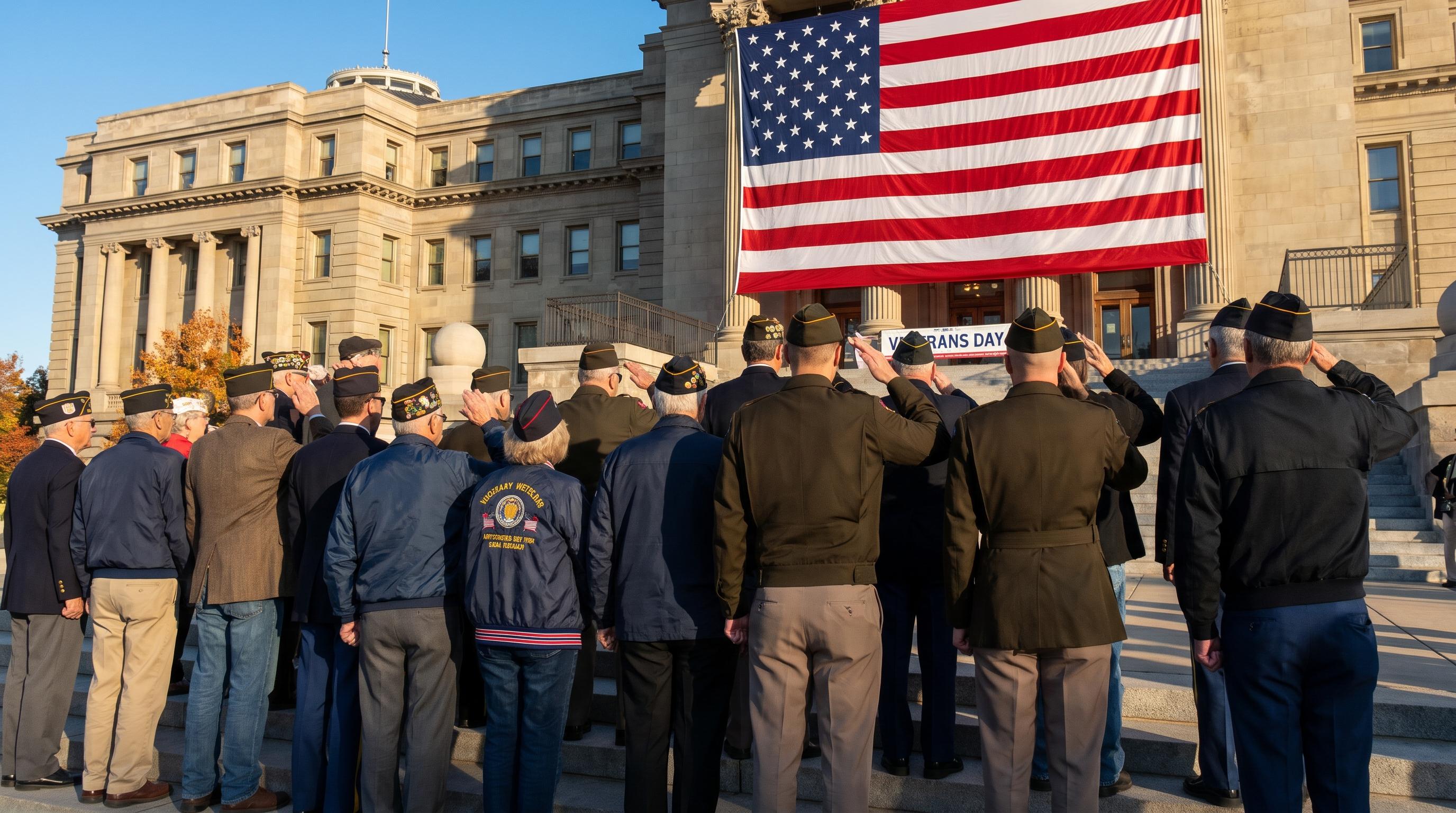
News -- November 12, 2026: Accoring to congressional records and press statements from lawmakers on both sides of the aisle, House Republicans passed the Take Care of America’s Veterans Act (TCAVA — H.R. 9237) on Veterans Day, November 11, using a fast-track voice vote. Under House rules, a voice vote takes place in seconds without a roll-call tally, meaning no individual member’s "yes" or "no" vote was entered into the official congressional record while most lawmakers were away from Washington attending holiday events in their home districts.
The roughly 600-page omnibus package, championed by House Veterans' Affairs Committee Chairman Mike Bost (R-Ill.) and House Republican leadership, combines roughly 60 veterans bills into a single measure. According to legislative text and Congressional Budget Office estimates, the bill pairs major benefit expansions with $57 billion in future Department of Veterans Affairs (VA) disability rating reductions and higher home loan refinancing fees—prompting sharp disagreement over both the policy trade-offs and the holiday floor procedure.
What Passed on Veterans Day
According to legislative summaries released by the House Veterans' Affairs Committee and reporting from Newsweek, H.R. 9237 includes both benefit expansions and future reductions:
Future Disability Rating Changes (Section 108), Current VA disability ratings are grandfathered in, meaning no veteran with a claim filed before October 1, 2026, would see a reduction. However, for claims filed on or after October 1, 2026—including active-duty service members and veterans who have not yet filed—Section 108 directs the VA to revise its rating criteria, eliminating the standalone 10% rating for tinnitus (compensating it only as a symptom of another service-connected condition) and ending the automatic 50% rating for sleep apnea treated with a CPAP device, shifting ratings to 0% or 10% when treatment controls symptoms.
VA Home Loan Refinance Fees: According to House Veterans' Affairs Committee Democrats, the funding fee for non-exempt borrowers using a VA Interest Rate Reduction Refinance Loan (IRRRL) nearly triples, increasing from 0.5% to 1.42%, while the fee to assume an existing VA mortgage doubles from 0.5% to 1%. Veterans with service-connected disabilities remain exempt.
Benefit Expansions: According to House Veterans' Affairs Committee Republicans and bipartisan co-sponsors such as Rep. Jared Golden (D-Maine), the package incorporates the Major Richard Star Act—allowing combat-injured medical retirees with fewer than 20 years of service to receive both longside the Love Lives On Act (preserving survivor benefits if a surviving spouse remarries before age 55) and expanded access to private healthcare through the VA Community Care program.
Dispute Over the Veterans Day Voice Vote
Because House leaders brought the bill to the floor during a holiday session and passed it by voice vote rather than a recorded roll call, no official list exists showing which representatives supported or opposed the measure on the floor. Critics' Perspective: House Veterans' Affairs Committee Ranking Member Mark Takano (D-Calif.) and Sen. Richard Blumenthal (D-Conn.) condemned both the Section 108 cuts and the use of a voice vote on Veterans Day. "They did it by voice vote, in seconds, with no roll call and no names," Takano said in an official committee statement, arguing that House Republicans used the procedure to avoid defending the cuts on the record and calling for a standalone vote on the Major Richard Star Act. Blumenthal called the floor action "a blatant abuse of established procedure—bypassing a fair vote". Veterans advocacy groups opposed to the cuts, including the Veterans of Foreign Wars (VFW) and Disabled American Veterans (DAV), similarly criticized passing future disability rating reductions during a holiday session without a recorded vote.
Supporters' Perspective: House Veterans' Affairs Committee Chairman Mike Bost and supporting lawmakers, including Rep. Mike Kelly (R-Pa.) and Rep. Jared Golden, defended the legislation as a historic bipartisan expansion of veterans' healthcare, survivor, and retirement benefits. Supporters and backing organizations—including The American Legion, Wounded Warrior Project, AMVETS, and Vietnam Veterans of America—maintained that moving the package during the compressed post-election session was necessary to give the Senate time to act before the end of the year, and that identifying budget offsets was required to advance long-stalled priorities like the Major Richard Star Act.
Supporters' Perspective: House Veterans' Affairs Committee Chairman Mike Bost and supporting lawmakers, including Rep. Mike Kelly (R-Pa.) and Rep. Jared Golden, defended the legislation as a historic bipartisan expansion of veterans' healthcare, survivor, and retirement benefits. Supporters and backing organizations—including The American Legion, Wounded Warrior Project, AMVETS, and Vietnam Veterans of America—maintained that moving the package during the compressed post-election session was necessary to give the Senate time to act before the end of the year, and that identifying budget offsets was required to advance long-stalled priorities like the Major Richard Star Act.V