

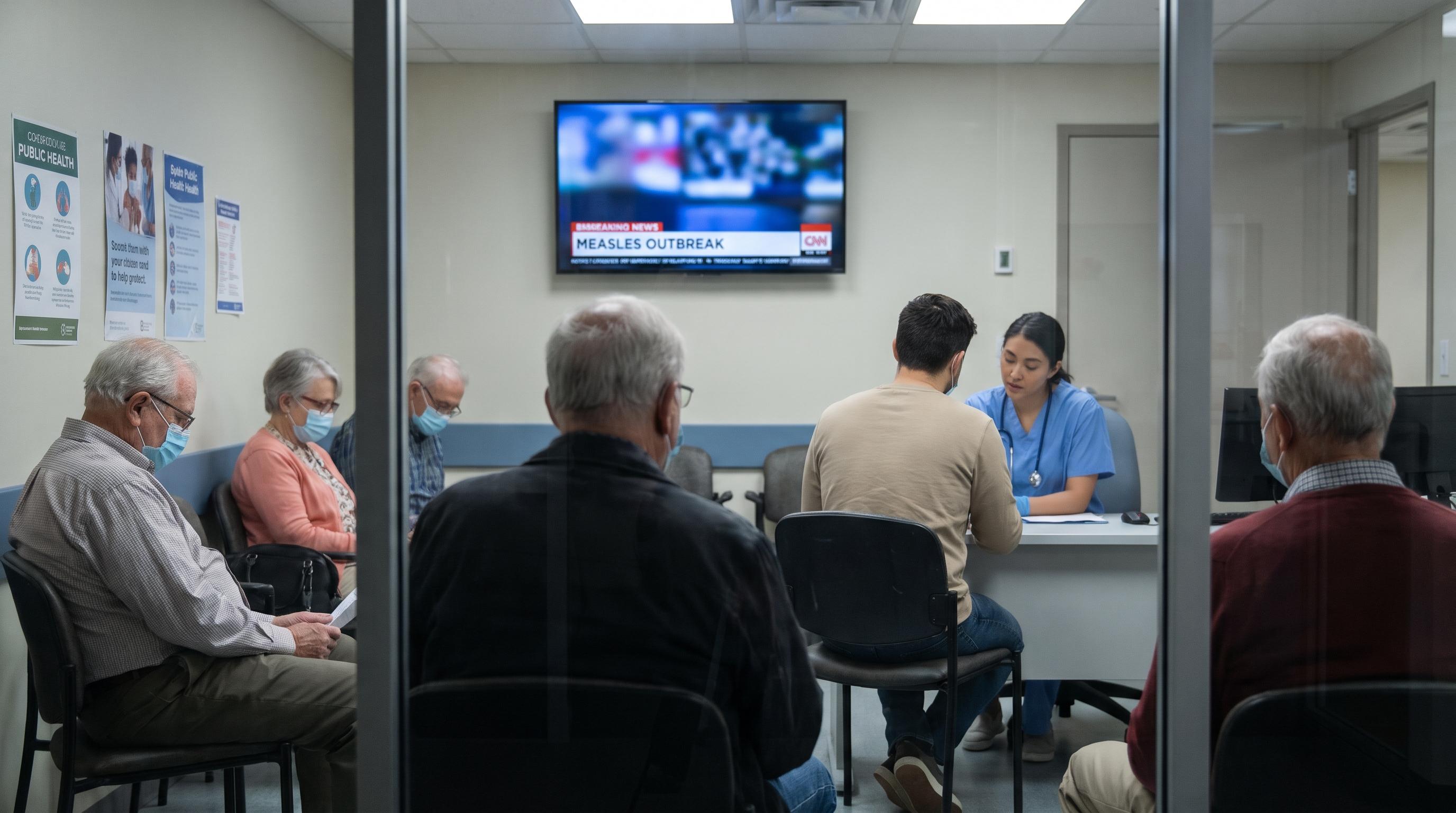
National News -- November 25, 2026: While measles has long been viewed primarily as a childhood illness, adults aged 20 and older now represent the single largest age group affected by the escalating U.S. measles resurgence. According to national surveillance data compiled from state health departments and tracked by the American Academy of Pediatrics (AAP) and the Pan American Health Organization (PAHO), adults account for 42% of all confirmed U.S. measles cases in 2026 (2,432 of 5,838 cases reported across 47 jurisdictions as of mid-November), up sharply from 29% across all of 2025.
While 2026 represents the highest raw annual case count since 1991—when 9,643 cases were recorded—public health historians emphasize that the current crisis is a far more alarming public health reversal. In 1991, measles had never been eliminated in the United States, and cases were falling rapidly (dropping from 27,672 in 1990 to roughly 2,200 in 1992) as a newly introduced two-dose vaccination policy took hold. In contrast, 2026 cases have more than doubled from 2025’s 2,289 cases and surged more than twentyfold from 285 cases in 2024. On November 17, 2026, PAHO—a regional arm of the World Health Organization—officially revoked the United States’ measles elimination status after continuous, uninterrupted transmission surpassed 12 months, erasing a public health milestone held since 2000.
Why Adults Face Heightened Risk
Although children and adolescents aged 5 to 19 make up 40% of 2026 cases (2,336 patients) and children under 5 account for 18% (1,035 patients), infectious disease specialists warn that measles carries severe clinical consequences when contracted in adulthood:
• Higher Hospitalization Rates: In 2026, 15% of infected adults (367 patients) have required hospitalization, compared with 4% of patients aged 5 to 19 (101 patients) and 17% of children under 5 (177 patients). Overall, 11% of all U.S. measles patients (646 people) have been hospitalized this year. • Severe Complications and Deaths: In adults, measles carries heightened risks of pneumonia, acute encephalitis (brain swelling), and prolonged immune system suppression that leaves patients vulnerable to secondary infections. While federal counts list 6 measles-related deaths in 2026 (double the 3 deaths recorded in all of 2025), state health departments—including Pennsylvania, Wisconsin, Virginia, and New York—have reported up to 14 measles-associated fatalities after federal officials removed confirmed state-reported deathsfrom public tallies. • Risks During Pregnancy: Public health alerts in 2026 have underscored significant dangers for pregnant individuals—including 14 cases among pregnant patients and a congenital newborn infection reported in Wisconsin alone—such as non-labor hospitalization, premature birth, and passing the virus across the placenta to newborns.
Which Adults Are Most Vulnerable?
State and national surveillance shows that 96% of all 2026 U.S. measles cases occurred in individuals who were unvaccinated or had an unknown vaccination status, while only 2% had received one dose and 2% had received two doses. Nearly all cases (96%) are linked to 43 distinct outbreaks reported across the country, with major transmission centers in Pennsylvania (more than 1,560 cases and multiple deaths) and Wisconsin (over 900 cases). Among adults, susceptibility is concentrated in several specific groups:
• People immunized between 1963 and 1967: Roughly 1 million Americans vaccinated during this window received an early "killed-virus" measles vaccine that was later found to be ineffective. Infectious disease specialists advise anyone vaccinated during those years without documentation of receiving a live-virus vaccine to get a modern MMR (measles, mumps, and rubella) shot. • Adults with only one dose: Routine two-dose MMR guidelines were not established until 1989. One dose provides roughly 93% protection, whereas two doses raise effectiveness to 97%. Healthcare workers, college students, and international travelers are specifically advised to verify two documented doses. • Adults born before 1957 (with exceptions): Because measles circulated widely prior to 1957, adults born before that year are generally presumed to have natural immunity, though healthcare workers in that bracket are still recommended to confirm immunity. • Immunocompromised individuals: Adults with weakened immune systems cannot safely receive the live-attenuated MMR vaccine and depend directly on surrounding coommunity immunity to avoid exposure.
What Adults Should Do Now
Because federal vaccine messaging has grown contested, independent medical societies—including the American Academy of Pediatrics (AAP), the Infectious Diseases Society of America (IDSA), the American Academy of Family Physicians (AAFP), the American College of Obstetricians and Gynecologists (ACOG), and state public health departments—urge adults to rely on established clinical guidelines and take four practical steps:
• Check Your Records—or Get an MMR Shot: Locate your childhood immunization records through your primary care doctor, state immunization registry, or former schools. Medical societies emphasize that verbal memory does not count as proof of immunity. If you cannot find written documentation—or if you were vaccinated between 1963 and 1967 with an early killed-virus vaccine—infectious disease specialists advise getting a live MMR vaccine rather than paying for an antibody titer blood test. Receiving an extra MMR dose is safe and carries no added risk for healthy adults who may already be immune. • Upgrade to Two Doses Before Travel or High-Risk Exposure: While one documented dose of MMR provides roughly 93% protection for general low-risk adults, clinical guidelines from IDSA, AAFP, and state health departments recommend two doses separated by at least 28 days (97% effective) for adults traveling internationally, working in healthcare, attending college, living with someone who is immunocompromised, or living in an active outbreak zone. • Act Immediately If You Are Exposed: Measles is so contagious that up to 90% of non-immune people close to an infected person will catch it, and the virus can linger in the air for up to two hours after an infected person leaves a room. If you are exposed and lack written proof of immunity, contact a physician or your local health department right away: receiving an MMR shot within 72 hours of exposure—or immune globulin within six days for pregnant or severely immunocompromised individuals (per ACOG and IDSA protocols)—can prevent the illness or reduce its severity.
• Call Ahead Before Going to a Clinic or ER: Symptoms typically appear 7 to 14 days after exposure (and up to 21 days), starting with a high fever, cough, runny nose, and red, watery eyes before the signature rash breaks out. If you suspect measles, call your doctor, urgent care, or emergency room before arriving so staff can isolate you and prevent exposing infants, pregnant women, and immunocompromised patients in the waiting room.
How Falling Immunization Rates and Policy Shifts Fueled the Resurgence
Epidemiologists and public health historians trace the return of endemic measles to a multi-year erosion of herd immunity—which requires at least 95% vaccination coverage to prevent sustained transmission—driven by pandemic-era disruptions, the growth of the anti-vaccine movement, and recent changes in federal health policy:
• Pandemic-Era Declines and Political Polarization: Routine childhood immunization rates began falling during the COVID-19 pandemic, dropping from 95.2% among U.S. kindergartners in the 2019–2020 school year to 92.4% in the 2025–2026 school year—leaving roughly 280,000 kindergartners without documented completion of the MMR series, with coverage declining across 39 states. During the pandemic response under the first Trump administration and in the years that followed, public health mandates became deeply polarized, accelerating vaccine skepticism and pushing school vaccine exemptions to a record 4.2% nationally across 41 states and Washington, D.C.
• Amplification Under HHS Secretary Robert F. Kennedy Jr.: Since taking office as Secretary of Health and Human Services in 2025, Robert F. Kennedy Jr.—a longtime critic of established vaccine science—has elevated vaccine skepticism to the center of federal health messaging. During the 2025–2026 outbreaks, Kennedy publicly questioned the effectiveness of the measles vaccine, promoted unproven nutritional and alternative therapies over immunization, and repeated debunked claims linking vaccines to autism.
• Overhaul of Federal Vaccine Recommendations and Data Interference: Under the current Trump administration and Kennedy’s leadership at HHS, federal agencies moved to scale back long-standing immunization guidance. In September 2025, a newly reconstituted federal vaccine advisory panel scrapped recommendations for the combined MMRV shot for young children. In January 2026, HHS announced a revised childhood immunization schedule reducing the number of universally recommended routine vaccines (though a federal judge blocked those schedule changes in March 2026 pending appeal). In August 2026, President Donald Trump signed an executive order calling to further pare back the core childhood schedule and split the combined MMR vaccine into three separate shots—which are not currently licensed or approved in the United States.
Medical organizations, including the American Academy of Pediatrics, have warned that scaling back federal recommendations, altering official death counts, and undermining public confidence in combined vaccines creates confusion for parents, prompts many to delay or skip childhood immunizations, and leaves growing pockets of both children and under-immunized adults exposed to one of the world’s most contagious viruses.